
Commercial Property Compliance: Does Your Property Manager Know What Needs to Be Done?
Owning a commercial property comes with a range of responsibilities.
Some are obvious. Others can quietly sit in the background until a contractor raises an issue, a tenant reports a problem, an authority requests documentation — or something goes wrong.
That raises an important question for commercial property owners:
Do you know what your compliance obligations are?
And perhaps more importantly:
Does your property manager?
Commercial property compliance can involve fire safety systems, backflow prevention, asbestos management, electrical and mechanical services, trade waste and a range of other requirements depending on the age, construction, location and use of the property.
For owners, particularly those with multiple properties or investments located interstate, it is reasonable to rely on their property manager to help keep these obligations on the radar.
But effective compliance management involves much more than simply booking a contractor when a service becomes due.
Compliance is not just another item on the maintenance calendar
There can be a tendency to treat compliance-related services like routine maintenance:
Book the contractor.
Receive the report.
Pay the invoice.
File the document.
Job done.
Except sometimes it isn't.
A contractor may have completed the required inspection or test but identified a defect requiring further action.
A piece of equipment may have failed testing.
A report may recommend repairs or further investigation.
Documentation may be incomplete or outdated.
A service may have been undertaken without anyone confirming whether all applicable requirements for the property have actually been addressed.
This is where there is an important distinction between organising compliance services and actively managing compliance.
What should compliance management involve?
Good compliance management should create a clear process from identifying an obligation through to confirming that any necessary action has been completed.
That may include:
identifying the compliance requirements relevant to the particular property;
maintaining appropriate registers, reports and supporting documentation;
scheduling required inspections, testing and servicing;
engaging suitably qualified contractors;
reviewing reports rather than simply filing them;
identifying defects, failures and contractor recommendations;
obtaining owner approval where rectification works are required;
following up outstanding works;
obtaining evidence that rectification has been completed; and
maintaining records for future reference.
In other words, a report sitting in an inbox doesn't fix a defect.
Someone needs to read it, understand what it means and make sure the appropriate next step happens.
What compliance requirements could apply to a commercial property?
There is no single checklist that applies identically to every commercial property.
A neighbourhood retail centre, medical premises, warehouse, office building and standalone commercial property can have very different requirements.
The obligations may also depend on the building's age, construction, installed services and how the premises are being used.
However, there are several areas commercial property owners should consider.
Fire safety and essential services
Depending on the building, fire safety requirements may involve systems and equipment such as:
fire extinguishers and fire blankets;
hose reels;
hydrants;
sprinkler systems;
fire detection and alarm systems;
emergency and exit lighting;
fire doors;
evacuation diagrams and procedures; and
required inspections, servicing, documentation and reporting.
For certain Queensland buildings, there may also be requirements relating to occupier statements and records associated with the maintenance of prescribed fire safety installations.
Importantly, arranging the scheduled inspection is only one part of the process.
What happens when the inspection identifies a defect?
That is where active follow-up becomes critical.
Case Study: When a Reported Defect Isn't Followed Through
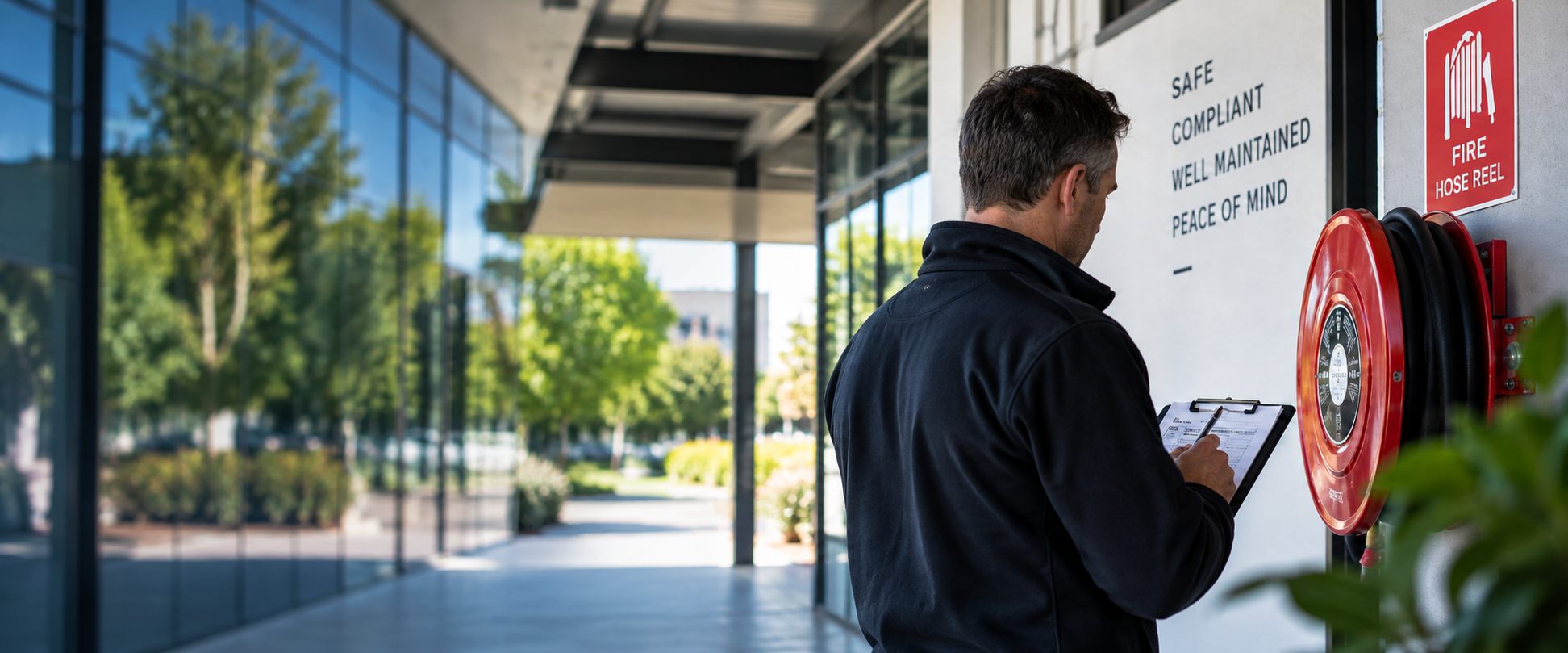
At a commercial property that recently came under our management, routine fire equipment servicing identified that one of the property's two fire hose reels had a handle that had rusted off, leaving the equipment unable to be operated as intended.
When we reviewed the property's previous service records, we discovered that the issue had been identified in earlier reports over a number of years, but the necessary repair had not been completed.
We immediately raised a workorder for the defective hose reel to be repaired.
The concerning question is simple:
What if there had been a fire and one of only two hose reels at the property wasn't operational when it was needed?
This is a good example of why compliance management can't stop when the contractor submits their service report.
Defects need to be identified, actioned and followed through to completion.
The lesson for owners: Don't just ask whether the required fire servicing has been completed. Ask whether any defects identified during that servicing have also been rectified.
Backflow prevention and plumbing
Some commercial properties have testable backflow prevention devices that require ongoing testing and may be subject to registration and reporting requirements with the relevant authority.
Other considerations can include:
trade waste requirements;
grease traps and associated systems;
plumbing infrastructure;
drainage systems; and
servicing requirements associated with particular commercial uses.
Food businesses, medical premises and other specialised occupancies can introduce additional considerations that may not apply to a standard office or warehouse.
Case Study: What Happens When the Records Aren't There?
When we recently took over the management of a large retail property, one of the areas we reviewed was the property's backflow prevention testing history.
The site has 24 backflow prevention devices, making this an important compliance item to actively track.
During our review, we were unable to locate evidence that the required testing had been completed for the previous year.
Rather than assuming it had been done, we immediately raised a work order with our licensed plumber to inspect and test the devices and establish their current status.
With 24 devices across one property, failing to properly track testing, servicing and any required rectification could quickly become a significant issue.
It also highlights another important aspect of compliance management:
If there is no record that something was completed, it needs to be investigated — not assumed.
Good property management means maintaining a clear compliance history so that the owner, property manager and relevant contractors can establish what has been completed, what is outstanding and what needs to happen next.
The lesson for owners: Your property manager should be able to tell you when your backflow devices were last tested, provide the relevant records and know when they are next due.
Asbestos management
Asbestos can be particularly important for older commercial properties.
Depending on the circumstances, owners and those managing workplaces may need to consider matters such as:
whether asbestos or asbestos-containing material may be present;
whether an asbestos register is required;
whether an asbestos management plan is required;
whether existing documentation remains current; and
whether relevant information is being provided to contractors before work is undertaken.
This can become especially important when renovations, maintenance or demolition works are proposed.
Discovering potential asbestos after a contractor has already opened a wall is not the ideal time to start looking for the property's asbestos documentation.
Electrical and other building services
Depending on the property, consideration may also need to be given to electrical installations and equipment, safety switches, lifts, mechanical services and other regulated plant or building systems.
Again, the important point is that requirements differ between properties.
Commercial property compliance should therefore start with understanding the individual asset rather than applying the same generic checklist to every building.
What happens when properties change property managers?
This is an area where problems can sometimes become apparent.
When a commercial property changes management, the incoming property manager may receive years of historical records… or surprisingly, very little.
There may be contractor reports, invoices and certificates spread across different systems and email accounts. There may be recommendations contained within old reports that were never followed up. Some documentation may simply be missing.
That doesn't necessarily mean the property is non-compliant.
But it does mean assumptions can be dangerous.
A good handover should therefore involve more than transferring leases, tenant ledgers and keys.
The property's maintenance and compliance history should also be reviewed so that outstanding matters can be identified and a reliable management framework established going forward.
Don't confuse a completed inspection with a completed obligation
This is perhaps one of the most important distinctions for commercial property owners.
Imagine a contractor attends a property to conduct scheduled testing.
The contractor completes the inspection and submits a report.
The invoice is paid.
On the surface, the task appears complete.
But the report identifies three defects requiring rectification.
Who is tracking those three defects?
Were quotes obtained?
Was the owner advised?
Were the works authorised?
Were they completed?
Was the system retested if required?
Was evidence of completion retained?
If nobody is responsible for that follow-through, a completed inspection can create the appearance that an obligation has been dealt with when there may still be outstanding actions.
Questions commercial property owners should ask
Owners don't necessarily need to become compliance experts themselves.
But they should have confidence that there is an appropriate system in place for their property.
Some useful questions to ask your property manager include:
What compliance requirements apply to my property?
Do we have all of the relevant registers, certificates, reports and records?
What testing or servicing is due during the next 12 months?
Have previous inspections identified any outstanding defects?
How are those defects being tracked through to completion?
Are there any gaps in the property's historical compliance documentation?
When was the property's overall compliance position last reviewed?
If those questions are difficult to answer, it may be worth taking a closer look.
Proactive property management protects the asset
Compliance isn't the most glamorous part of commercial property ownership.
There probably aren't many investors who purchase a property because they're excited about backflow testing or fire door inspection reports.
But these seemingly mundane details form an important part of protecting the property, its occupants and the owner's investment.
They can also help identify maintenance issues before they become larger problems and provide owners with greater visibility over the condition and operation of their asset.
Most importantly, good compliance management provides owners with something valuable:
Confidence that someone is paying attention.
At Ambit Property, our approach to commercial property management is proactive.
We believe property management should involve understanding the asset, identifying what needs attention, maintaining appropriate records and following issues through — rather than simply responding when something goes wrong.
Because when it comes to commercial property compliance, the important question isn't simply:
“Was the contractor booked?”
It's:
“Was everything that needed to happen actually completed?”
Key Takeaways
Commercial property compliance can be complex, and the requirements will vary depending on the property, its age, use, services and other circumstances.
But there are a few principles every commercial property owner should keep in mind:
1. Don't assume it has been done — If testing, servicing or an inspection is required, there should be a record confirming when it was completed and the outcome.
2. A completed test doesn't necessarily mean everything is compliant — Testing may identify defects, failed equipment or further work that needs to be completed. Those items need to be tracked through to rectification.
3. Contractor reports need to be reviewed, not simply filed — Someone needs to read the report, understand the findings and act on any recommendations or defects.
4. Good records matter — Registers, certificates, test results, service reports and evidence of rectification create an important compliance history for the property… particularly when ownership or property management changes.
5. Every property is different — A retail centre, medical premises, office, warehouse or standalone commercial building may have very different requirements. Compliance should be considered at an individual property level rather than relying on a generic checklist.
6. Compliance needs ongoing management — Some requirements arise every six months or annually, while others may only occur every few years. Without a system for tracking future dates, longer-term obligations can easily be overlooked.
7. Changing property managers is an opportunity to review — When a property comes under new management, reviewing its compliance records and servicing history can help identify missing documentation, overdue testing and outstanding defects.
And perhaps the most important takeaway:
Compliance isn't complete when the contractor attends the property. It's complete when the required testing has been undertaken, the results have been reviewed, any necessary action has been followed through, and the appropriate records are retained.
For commercial property owners, the question shouldn't simply be:
“Are my compliance services being booked?”
It should be:
“Is someone actively managing my property's compliance?”
How confident are you about your property's compliance?
If you're unsure whether your commercial property's compliance requirements are being actively managed, a review of the property's existing records, servicing history and outstanding items can be a useful place to start.
Talk to Ambit Property about a Commercial Property Health Check.
For investors, by investors.
Professional management. Personal care.
Get In Touch
Whether you’re a landlord, investor, buyer, or tenant, we’re here to help you make the most of your property. Contact us for a free, no-obligation chat about how we can support your real estate goals.
Frequently Asked Questions (FAQs)
-
There isn't one compliance checklist that applies to every commercial property.
Requirements can depend on factors including the property's age, construction, use, location, installed services and the activities undertaken by its occupants.
Depending on the property, compliance considerations may include fire safety systems, emergency and evacuation procedures, backflow prevention, asbestos management, electrical installations, lifts and other plant, trade waste and other building services.
The starting point should be identifying what actually applies to the individual property.
-
Responsibility can vary depending on the particular legal requirement, the nature of the property and the terms of the lease.
Some obligations may sit with the property owner or occupier, while leases may allocate responsibility for certain servicing, maintenance or costs between the landlord and tenant.
A property manager may coordinate and monitor these requirements on behalf of an owner, but appointing a property manager does not necessarily transfer an owner's statutory responsibilities.
This is why both the applicable legislation and the individual lease need to be considered.
-
Compliance shouldn't only be reviewed when something goes wrong.
A property should have a system for tracking recurring testing, servicing and inspections as they become due. Some requirements may occur every six months or annually, while others may operate over longer cycles.
It is also sensible to undertake a broader review when a property changes ownership or property manager, when its use changes, when significant building works are proposed, or when new equipment or services are installed.
-
The inspection should not simply be marked as completed and the report filed away.
The defect should be reviewed, the appropriate party notified, any necessary quote or further investigation arranged, rectification authorised and completed, and evidence of completion retained.
Depending on the issue, further testing or certification may also be required.
Identifying a defect is only the beginning — the important part is closing it out.
-
Start by establishing what records are available and identifying the gaps.
Existing contractors, previous reports, invoices, certificates and relevant registers may help reconstruct some of the property's compliance history.
Where evidence of required testing or servicing cannot be located, the appropriate next step may be to have the requirement assessed or the relevant testing undertaken rather than simply assuming it was previously completed.
This also creates a reliable baseline for managing the property going forward.
-
Not necessarily. Requirements depend on the circumstances of the property, including whether it is a workplace, when it was constructed and whether asbestos or asbestos-containing material is present or likely to be present.
Where the relevant requirements apply, an asbestos register and, in certain circumstances, an asbestos management plan may be required and need to be maintained and reviewed.
Older commercial properties should therefore be assessed on their individual circumstances rather than assuming that asbestos requirements either do or don't apply.
-
Not necessarily.
Testing may identify defective equipment, failed components, overdue repairs or recommendations requiring further action.
That's why effective compliance management involves more than maintaining a calendar of service dates. It requires reviewing the results and tracking any outstanding items through to completion.
-
A proactive commercial property manager should help the owner maintain visibility over the property's compliance requirements.
Depending on the scope of their appointment, this may include maintaining records, tracking recurring dates, engaging appropriately qualified contractors, reviewing reports, bringing defects and recommendations to the owner's attention and following authorised rectification works through to completion.
Most importantly, your property manager should be able to answer some fairly basic questions:
What is due? What has been completed? What defects are outstanding? And what happens next?
If those questions can't readily be answered, it may be time for a closer review of the property's compliance management.
About The Author
Jo Baulch is the Founder and Director of Ambit Property, a Brisbane based property management agency built on the belief that owning real estate should be rewarding, not overwhelming.
After years of managing her own residential and commercial investment properties, Jo saw how reactive management and poor communication were holding landlords back. With a background in business systems and deep experience as an investor, she created Ambit Property to deliver strategic, transparent, and accountable property management across Brisbane and South-East Queensland.
DISCLAIMER: This article is general information only and does not constitute financial, legal, or property investment advice. Market conditions and individual circumstances vary. Before making decisions about your property, you should seek advice tailored to your specific situation.