
Common Mistakes Commercial Landlords Make When Self-Managing
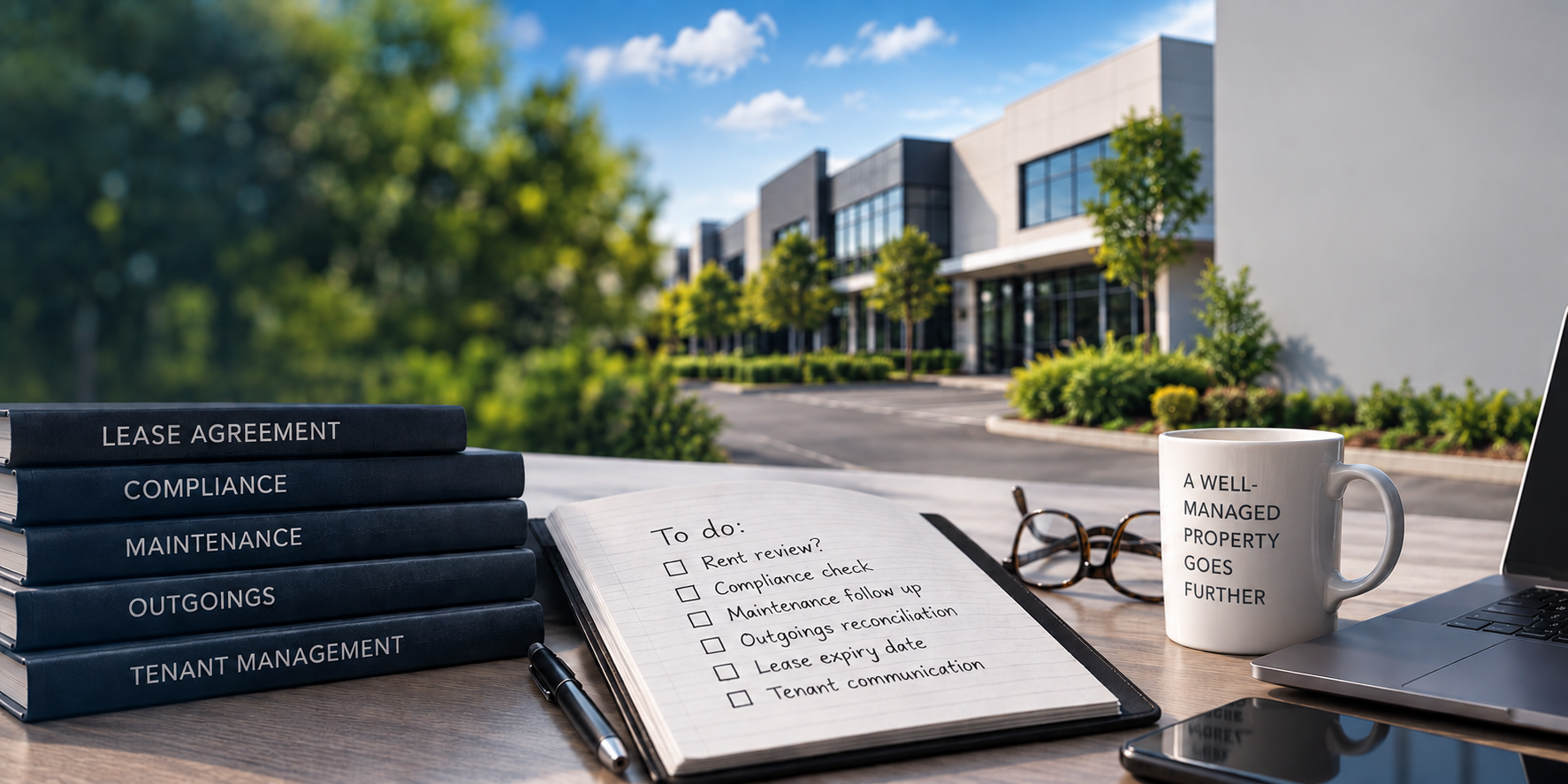
Owning a commercial investment property can be very different from owning a residential investment.
The leases are typically longer and more complex, the financial commitments can be greater, and responsibility for repairs, maintenance, compliance and outgoings can vary considerably from one lease to another.
For experienced commercial property owners, self-management can initially seem straightforward: issue the rent invoices, arrange repairs when something breaks, review the rent when required and keep in touch with the tenant.
But effective commercial property management involves considerably more than collecting rent.
Many of the problems we see aren't caused by landlords deliberately neglecting their properties. They arise because something was overlooked, misunderstood or simply wasn't followed up.
And unfortunately, small oversights can become expensive problems.
Here are some of the most common mistakes commercial landlords can make when self-managing their properties — and why having an experienced commercial property manager can make a significant difference.
1. Not Knowing the Lease Well Enough
The lease is effectively the operating manual for the tenancy.
Yet one of the most common problems in commercial property management is that decisions are made based on assumptions rather than the actual lease provisions.
Who is responsible for maintaining the air conditioning?
Who pays for plumbing repairs?
Can certain expenses be recovered through outgoings?
When does the rent increase?
What happens when an option is exercised?
Who is responsible for servicing fire equipment?
What are the tenant's make-good obligations when they leave?
The answers can vary significantly between leases — even between different tenancies within the same property.
A commercial property manager should understand the lease, maintain a clear record of critical obligations and dates, and refer back to the lease whenever an issue arises.
A landlord who assumes "the tenant pays for everything" may discover that the lease says otherwise.
Conversely, a landlord may unnecessarily pay for something that was actually the tenant's responsibility.
The mistake: Managing based on assumptions rather than the lease.
The better approach: Treat the lease as the primary reference point for every tenancy.
2. Missing Important Lease Dates
Commercial leases contain numerous critical dates.
These may include:
rent reviews;
CPI or market reviews;
option exercise periods;
lease expiries;
insurance renewal requirements;
bank guarantee expiry dates; and
notice periods.
Missing some of these dates can have significant financial consequences.
For example, failing to implement a rent review may result in months of undercharged rent. Missing an option notice period can create uncertainty around the future tenancy. Allowing a bank guarantee to expire can weaken the landlord's security position.
Commercial property management requires more than putting the lease expiry date in a calendar.
At Ambit Property, we believe important lease dates should be actively monitored well before action is required.
Because discovering a critical date the week after it passed isn't much of a reminder.
Case Study: The Rent Review That Was Never Applied
When taking over the management of a commercial property, one of the first things we do is review the leases and establish the critical dates and obligations for each tenancy.
During these reviews, we have discovered leases where a scheduled rent review had passed but the increase had never been applied.
It can be an easy oversight, particularly where a tenancy has been running smoothly and the tenant continues paying the same rent each month. But depending on the lease, the size of the increase and how long the review has been missed, the financial impact can add up quickly.
It can also affect future rent reviews, property income and ultimately the property's investment performance.
The lesson: Never assume the current rent is the correct rent. Every lease should have its rent review dates and methodology recorded and monitored so the appropriate action can be taken when the review falls due.
3. Treating Compliance as a "Set and Forget" Exercise
Commercial buildings can have numerous ongoing compliance obligations depending on the property, its use and the services installed.
These may include fire safety systems, emergency and evacuation procedures, backflow prevention devices, essential services, electrical systems, asbestos management requirements and other statutory obligations.
One of the risks with self-management is assuming that because something was tested last year, someone will automatically organise it again this year.
That isn't always the case.
Contractors change. Property managers change. Records disappear. Service agreements expire.
When taking over management of commercial properties, we sometimes discover gaps in documentation or testing that should previously have been completed.
Good commercial property management means maintaining a compliance calendar, retaining records and certificates, following up contractors and identifying gaps before they become problems.
Compliance should be actively managed — not assumed.
4. Waiting Until Maintenance Becomes Urgent
Reactive maintenance is usually more expensive than planned maintenance.
A small roof leak can become internal water damage.
A deteriorating air-conditioning system can fail during summer.
A blocked drain can become an emergency plumbing callout.
A pothole can become a safety issue.
A minor building defect can become an insurance problem.
Self-managing landlords can understandably delay expenditure where an issue doesn't appear urgent. But commercial property management requires balancing today's maintenance cost against tomorrow's potential liability and capital expenditure.
Regular inspections, preventative maintenance and early investigation can help identify issues while there are still options available.
The cheapest repair isn't necessarily the one with the lowest invoice today.
Case Study: The Air Conditioner That Had Been Failing for Some Time
We recently had a commercial tenant advise us that their air-conditioning system had failed and was no longer adequately cooling the tenancy.
As part of our investigation, the tenant provided previous service records relating to the system. Those records indicated that problems with the ageing equipment had been identified for some time, but the issue had not previously been progressed.
By the time the problem came to us, the system had reached the point where replacement needed to be considered rather than simply routine maintenance.
This highlights why contractor reports shouldn't just be filed away after a service is completed.
Comments such as unit nearing end of life, refrigerant obsolete, component deteriorating or replacement recommended may not require immediate capital expenditure, but they should trigger follow-up and forward planning.
That can give the landlord time to investigate options, obtain competitive quotations and budget for future expenditure rather than dealing with an unexpected failure.
The lesson: Maintenance isn't just about fixing what has already broken. Contractor recommendations can provide valuable early warning of future capital expenditure.
5. Not Understanding Who Is Responsible for Repairs
This is one of the most common sources of disagreement between commercial landlords and tenants.
A tenant reports an air-conditioning failure.
Who pays?
A plumbing fixture breaks.
Who pays?
A roof leak damages the tenant's fitout.
Who repairs what?
The answer may depend on several provisions of the lease — maintenance obligations, capital replacement clauses, services provisions, outgoings definitions and sometimes the circumstances that caused the problem.
Immediately telling the tenant "that's your responsibility" — or automatically arranging the repair at the landlord's expense — can both create problems.
The correct approach is to investigate the issue, review the relevant lease provisions and determine responsibility before allocating costs wherever practicable.
Case Study: A Plumbing Repair — But Who Actually Pays?
A tenant recently contacted us to report a water leak underneath a sink and requested that a plumber attend.
The immediate priority was straightforward: investigate the leak and prevent further water damage.
The plumber identified the cause as worn flexible hoses connected to the tapware.
But determining who should ultimately bear the cost required another step — reviewing the lease.
The relevant maintenance provisions indicated that responsibility for this type of maintenance rested with the tenant.
Without checking the lease, it would have been very easy for the landlord to simply arrange and pay for what appeared to be a minor plumbing repair.
On an individual invoice, the amount may not seem significant. But across a commercial property over many years, repeatedly paying expenses that properly sit with the tenant can add up.
Equally, landlords shouldn't automatically assume every internal repair is a tenant expense. Responsibility needs to be determined from the particular lease and the circumstances of the repair.
The lesson: Fix the problem promptly — but before allocating the cost, understand what caused it and check the lease.
6. Poor Record Keeping
Commercial property disputes often come down to documentation.
What did the contractor recommend two years ago?
Was the tenant previously advised about the issue?
When was the air conditioner last serviced?
Was the rent review implemented?
Did the tenant provide their insurance certificate?
Was a maintenance recommendation ever actioned?
Without organised records, answering these questions can become difficult.
A well-managed commercial property should have accessible records covering leases, correspondence, inspections, maintenance, compliance, insurance, financial transactions and contractor reports.
Good records don't just make administration easier.
They can be extremely valuable when there is a dispute, insurance claim, lease negotiation or property sale.
7. Being Too Informal With the Tenant
Having a good relationship with your commercial tenant is valuable.
But there is a difference between having a good relationship and managing the tenancy informally.
"Don't worry about the rent this week."
"We'll sort the lease renewal out later."
"Just go ahead with the alteration."
"We'll work out the costs afterwards."
Those conversations may seem harmless at the time.
Months later, memories can differ.
Good property management creates appropriate documentation around agreements, approvals, rent arrangements, alterations, maintenance responsibilities and lease variations.
Professional management doesn't need to damage the landlord-tenant relationship.
In many cases, it actually protects it by making expectations clear.
8. Allowing Arrears to Drift
Commercial rent arrears rarely improve because nobody talks about them.
A tenant may have a genuine temporary cash-flow issue, and landlords will sometimes choose to provide flexibility.
That can be a perfectly reasonable commercial decision.
The mistake is allowing informal arrangements to continue without clear documentation or monitoring.
A structured arrears process allows the landlord to understand:
how much is outstanding;
when it became due;
what the lease provides;
what payment arrangements have been agreed; and
whether those arrangements are being met.
Early communication also gives landlords more options.
The longer arrears continue, the fewer comfortable options there may be.
Case Study: Changing the Culture Around Rental Arrears
When we took over management of one commercial property, a number of tenants were regularly in arrears.
This wasn't an occasional late payment. Late payment had effectively become part of the normal pattern at the property and had been occurring for some time.
Working with the landlord, we introduced a more structured approach to arrears management.
Where appropriate under the relevant leases, this included applying the lease provisions relating to interest on overdue amounts. For a more serious ongoing arrears matter, the landlord's lawyer was engaged to issue a formal notice to remedy breach.
We also introduced a systematic arrears process across the property.
Tenants receive escalating arrears communications when amounts remain outstanding at 1–7 days, 8–14 days, 15–20 days and 21+ days, rather than allowing overdue rent to quietly accumulate.
The result has been a noticeable change in payment behaviour.
Tenants who had previously been regularly late are now generally paying on time or making payment shortly after receiving an arrears reminder.
Importantly, this isn't about unnecessarily taking an aggressive approach with tenants.
It's about creating clear expectations and applying a consistent process. If a tenant has a genuine issue, early communication also provides an opportunity to understand the situation and discuss it with the landlord before the arrears become significantly larger.
The lesson: Arrears management is most effective when it is consistent, documented and started early. Allowing late payment to become normal can make the problem much harder to correct later.
9. Poor Management of Outgoings
Outgoings are another area where seemingly simple administration can become complicated.
Depending on the lease, recoverable expenses may include council rates, water charges, insurance, cleaning, landscaping, pest control, fire services and other operating expenses.
But not every expense is necessarily recoverable.
Different tenants within the same centre may also have different lease provisions, proportions or exclusions.
Owners need to consider budgets, monthly recoveries, expenditure allocation and annual reconciliations.
Incorrectly recovering expenses can lead to disputes. Failing to recover legitimate expenses can quietly reduce the property's net return.
Neither outcome is particularly attractive.
10. Leaving Lease Renewals Until the Last Minute
A commercial lease renewal should rarely begin a few weeks before expiry.
Landlords need time to consider market rent, incentives, lease structure, tenant performance and their broader investment strategy.
Tenants also need certainty.
Starting discussions early gives both parties time to negotiate properly and allows the landlord to consider alternatives if an agreement cannot be reached.
For commercial owners, lease expiry isn't simply an administrative date.
It's an asset-management decision.
11. Focusing on Rent Collection Instead of Asset Management
Perhaps the biggest mistake is viewing commercial property management primarily as rent collection.
Rent collection is important — but it's only one component.
Effective management should also help protect the physical asset, preserve lease income, monitor tenant obligations, manage risk, maintain documentation and identify issues before they become expensive.
The question shouldn't simply be:
"Has the rent been paid?"
It should also be:
"Is this property being managed in a way that protects its income, condition and long-term value?"
Commercial Property Management Should Be Proactive
Self-managing a commercial property is certainly possible.
But doing it well requires time, systems, lease knowledge, contractor management, financial oversight and consistent follow-up.
And the challenge often isn't dealing with the obvious problems.
It's identifying the things that haven't happened yet.
The compliance test that hasn't been scheduled.
The rent review that is approaching.
The maintenance recommendation that hasn't been actioned.
The insurance certificate that hasn't been renewed.
The lease option that needs attention several months from now.
Those details are where professional management can add significant value.
Key Takeaways
Self-managing a commercial property can appear straightforward, particularly when you have a reliable tenant and few day-to-day issues. But many of the biggest risks in commercial property management sit quietly in the background.
For commercial landlords, some of the most important things to remember are:
Know your lease. Responsibilities for maintenance, repairs, outgoings, insurance and other costs can vary significantly between leases. Don't rely on assumptions.
Monitor critical dates. Rent reviews, options, expiries, bank guarantees and notice periods should be tracked well in advance.
Stay on top of compliance. Fire safety, backflow prevention, asbestos requirements and other compliance obligations need active monitoring and good record keeping.
Don't defer maintenance unnecessarily. Small building issues can become expensive repairs, safety risks or insurance problems if they aren't investigated early.
Document agreements with tenants. A good relationship is important, but significant agreements and approvals should still be recorded in writing.
Manage arrears early. Flexibility may sometimes be appropriate, but payment arrangements should be clear, documented and monitored.
Understand your outgoings. Know what the lease allows you to recover and ensure expenses are correctly budgeted, allocated and reconciled.
Start lease renewals early. A lease renewal is an opportunity to consider the property's income, tenant retention and longer-term investment strategy.
Think beyond rent collection. Good commercial property management is ultimately about protecting the property's income, condition and long-term value.
The common thread is proactive management.
Problems are generally easier — and often considerably less expensive — to deal with when they're identified early.
A Smarter Approach to Commercial Property Management
At Ambit Property, we're property investors ourselves, so we approach commercial property management from an owner's perspective.
Our focus isn't simply collecting rent and forwarding statements.
We actively manage the property, leases, maintenance, compliance, contractors and tenant relationships with the aim of protecting the owner's investment and reducing unpleasant surprises.
We believe commercial properties should be managed like they're our own.
For landlords who are currently self-managing — or wondering whether their existing management arrangements are giving their property enough attention — a fresh review can often identify opportunities, risks or gaps that aren't immediately obvious.
Professional management. Personal care.
If you'd like to understand how your commercial property is currently performing from a management perspective, talk to Ambit Property about a Property Health Check or Free Appraisal.
Because good commercial property management isn't just about dealing with today's problems.
It's about preventing tomorrow's.
Get In Touch
Whether you’re a landlord, investor, buyer, or tenant, we’re here to help you make the most of your property. Contact us for a free, no-obligation chat about how we can support your real estate goals.
Frequently Asked Questions (FAQs)
-
Yes. Commercial property owners can manage their own properties, and some experienced investors choose to do so.
However, self-management requires more than collecting rent and arranging occasional repairs. Owners need systems for monitoring lease obligations, critical dates, rent reviews, arrears, maintenance, compliance, insurance documentation, outgoings and tenant communications.
The real question isn't simply whether you can self-manage — it's whether you have the time, knowledge and systems to manage the property proactively.
-
A commercial property manager typically manages the ongoing relationship between the landlord, tenant, property and lease.
Depending on the property and management appointment, this may include rent collection, arrears management, rent reviews, lease administration, maintenance coordination, contractor management, compliance monitoring, inspections, outgoings budgets and reconciliations, insurance documentation and lease renewal coordination.
Good commercial property management should go beyond administration and help the owner protect the performance and condition of the asset.
-
There is no single inspection frequency appropriate for every commercial property.
The appropriate schedule will depend on factors such as the property type, lease arrangements, age and condition of the building, tenant use and any known maintenance issues.
The important point is that inspections should be systematic rather than occurring only when something goes wrong.
Regular inspections can help identify deterioration, unauthorised alterations, maintenance issues, housekeeping concerns and potential safety risks before they become larger problems.
-
It depends on the lease.
Commercial leases can allocate responsibilities very differently. A tenant may be responsible for maintaining certain equipment or services while the landlord remains responsible for structural components or capital replacement. In other situations, the allocation may be different again.
Before deciding who should pay for a repair, the issue should be properly investigated and the relevant lease provisions reviewed.
This is one area where assumptions can become expensive.
-
Compliance requirements vary depending on the property, its location, use, building services and applicable legislation.
Depending on the property, obligations may involve areas such as fire safety systems, emergency and evacuation procedures, backflow prevention, electrical safety, asbestos management and other building or essential-service requirements.
An important part of commercial property management is identifying which requirements apply to a particular property and maintaining appropriate records, testing and servicing schedules.
-
Ideally, well before the lease expires.
The appropriate timeframe will depend on the lease, including any option provisions and required notice periods. However, leaving renewal discussions until the final few weeks can unnecessarily restrict both the landlord's and tenant's options.
Starting early gives the owner time to consider market conditions, proposed rent, incentives, tenant performance, required works and the longer-term strategy for the property.
-
That depends on the property and the owner's circumstances.
A management fee should be considered against the time involved in self-management and the potential financial impact of missed rent reviews, unrecovered outgoings, prolonged arrears, deferred maintenance, compliance gaps or poorly managed lease events.
For many investors, the value of professional management isn't simply the administration that is performed. It's having someone consistently watching the property, lease and critical dates on the owner's behalf.
About The Author
Jo Baulch is the Founder and Director of Ambit Property, a Brisbane based property management agency built on the belief that owning real estate should be rewarding, not overwhelming.
After years of managing her own residential and commercial investment properties, Jo saw how reactive management and poor communication were holding landlords back. With a background in business systems and deep experience as an investor, she created Ambit Property to deliver strategic, transparent, and accountable property management across Brisbane and South East Queensland.
DISCLAIMER: This article is general information only and does not constitute financial, legal, or property investment advice. Market conditions and individual circumstances vary. Before making decisions about your property, you should seek advice tailored to your specific situation.